Posted by: E (The Third Glance) | May 24, 2013

My Favorite Book…

A couple of days ago, I posted on my facebook page that I had sent an email to my favorite author, and he had written back. I want to expand a little upon this, because it’s just so very cool. Up until about 2 years ago, I was a voracious reader. But I hadn’t actually had a favorite book in a long, long time. Certainly there were authors I admired, books I read for comfort, but really, I couldn’t answer the question “what’s your favorite book?” And then I stumbled across The Name of the Wind by Patrick Rothfuss, and my world changed. I had a favorite book that I think will stick with me for a very VERY long time. I recently saw a fantastic compilation called “13 Fantasy Books that are good despite their covers” – Rothfuss’s book is #12, and the review says

“The (hands down) best high-fantasy series written in the last 20 years. If you haven’t read it yet and you like fantasy, immediately start reading it now.”

That basically sums up my opinion pretty well. It is phenomenal. I like it significantly better than Tolkien, and I’ve read nearly everything he’s written. (I know, blasphemy, but hear me out.) Rothfuss is an extremely thoughtful writer, who has an incredible skill for weaving a story and building worlds, people, languages, and cultures. And as if that weren’t enough for a great story, his prose is some of the most elegant I have ever encountered. Despite being long (when has this ever been an issue?) it is incredibly readable, and I never noticed the length when reading, except that I was so sucked in that I looked up at 3am, 6 hours past my bedtime… Technically, the book is the first in a trilogy (called The Kingkiller Chronicles), of which the first two are published (Book 2 is called The Wise Man’s Fear). Book 3 is in the works, and while I am incredibly excited to read it, I think the longer it takes the better it will be. And besides, I can read and re-read books 1 and 2 again and again. The joy of these books is that each time I read them, I notice something new and amazing. There’s a moment in the second book where I realize that when the main character is in a particular world, he and everyone else speaks in verse. You wouldn’t notice it if you’re reading quickly – it’s written as prose. But slow down and savor the words, and you’ll notice a rhyming and a cadence. That’s just one of the many amazing parts of the book. I could gush for hours about how incredible it is, but I might give some parts away. So go read it for yourselves.

I also follow Pat’s blog (and you can too), because not only is he an incredible writer, he’s just an all-around awesome person. In addition to doing awesome things like writing short stories and collaborating on all number of interesting projects, Pat goes out of his way to help young writers. And he also runs a charity called Worldbuilders, which benefits Heifer International in an incredible way that brings people together in a way I’ve never seen before. But in general, Pat presents as a really cool, nice guy. And so, after months of agonizing, writing, and re-writing, I finally screwed up my courage and hit “send” on an email that I’d written to Pat, which I’ll be posting an edited version of (you’ll hopefully see why I’m waiting soon).

And not only did he read it, he took the time to write me back and thank me for my note and even commented on the content. And I haven’t stopped grinning since. (There’s also been a fair bit of flapping, bouncing, and general excited stimming) So I just wanted to say thank you, Pat, for being amazing, and for taking your precious time to read and respond to your readers hundreds of emails. And for being just as awesome as you seem.

And, dear readers, if you haven’t read his books yet, you 100% should. They are worth every minute and then some.

p.s. What has this to do with Autism? Just you wait, you’ll see… It definitely does. But it also contains a bit of a spoiler alert… so you have been forewarned. Plus, now you have to read the books before I post the letter! ;)

Posted by: E (The Third Glance) | May 12, 2013

Academia and Autism: Autism Acceptance Part 3

I know it’s no longer April, but Autism Acceptance is not a month-long thing, and I’ve been super overwhelmed with work and everything else in my life (I’m [hopefully] about to become a PhD candidate – just 3.5 more weeks until my exam). So I thought I would continue this little series on and off for a while. The first two Autism Acceptance posts are found here and here.

——————————

Sometimes it’s the things that people do that make you know they really get you. I just wanted to share a couple little vignettes about what autism acceptance can look like, even in a professional (if you could call my world-class institution “professional”) setting.

——————————

The other day, I was sitting with one of my committee members discussing a part of my thesis. We were chatting about some mathematical equations involved with the project, and as I could see where he was going, I started filling in what he was pointing out, to show that I understood him. Then I made a really neat leap of logic. I was really excited by it, and I bounced in my chair and flapped my hands a little. The professor grinned, and said “wow, that’s brilliant!”, then he flapped a little bit back, and we resumed discussion of the project.

——————————

My advisor and I have worked together for several years, and we get along really well. He’s one of the main reasons I went to the particular PhD program I am in. I can tell tons of stories like this about him, but this one is one of my favorites. Last year, around this time, I was preparing for my first-year oral exam. I had just undergone my mock examination, during which 5 older students had impersonated the different committee members and interrogated me for an hour and a half. Afterwards, I was debriefing with my advisor. I told him that my biggest bit of feedback was that I needed to stop bouncing on my toes and moving my hands so much. I said “you know how I get when I’m excited or nervous”, demonstrating my hands flapping and twisting, “how I get bouncy and stuff”. And he looked at me, grinned, and responded “Yes, and I think it’s wonderful!”

——————————

And THIS is what autism acceptance looks like. Academia is pretty awesome, isn’t it?


Posted by: E (The Third Glance) | April 30, 2013

E (The Third Glance) Celebrates 1000 Ausome Things! #AutismPositivity2013


Ahh, this year’s flash blog. It’s been an interesting one this year, putting it all together. But you know, that’s one of the best things about being Autistic. I get to be me, and by just being me, I can help others. The hyper-focus that I can maintain while constantly scheduling and updating the wordpress site definitely help too…

But on a more serious note, what are some of my favorite parts of being autistic? What makes being autistic “ausome”? Lots of things. Here are just a few things that I love about being autistic:

My stuffed animals. At 23, I have over 300 stuffed animals (312 to be exact) and I love every single one of them. They bring me great joy, and I love snuggling with them. If you ever want to make me happy, give me a stuffed animal.

Being a PhD student. I get to spend all day, every day, learning about my favorite subject in the world. I’m paid to perseverate on it. If that’s not ausome I don’t know what is.

Having super-senses. Sometimes this is not so ausome. I often get overloaded and this can lead to meltdowns. I have trouble eating and wearing most types of clothes (but not clothes is an even worse option!) But I rally do enjoy being able to hear everything that goes on all over the place. I like knowing what’s going on and how to find it.

Facts. Facts are awesome. There are lots of facts. I take pride in being a walking encyclopedia about a number of things, and really enjoy learning new facts.

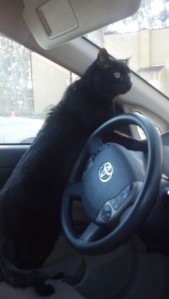
My kitty, who is without a doubt an autistic cat. He’s a sweet, loving cuddly feline who is terrified of loud noises and people, except me. I think my neurology gives us a special bond. He was in the shelter for 9 months before I took him home.

Flapping for joy. Stimming for the love of the movement. Twirling in the rain. (as long as I can dry off immediately after :P )

Playing the piano for hours on end while I let the music carry me away from where I am.

My wonderful friends who take me as I am and celebrate me for it. Those people who take The Third Glance.

And finally, knowing that I am autistic is one of the most ausome things about autism. Knowing that there is a “why” for all the reasons I’m different from my peers. That there’s an explanation for all the horrors of my childhood, for all the difficulties I face on a daily basis. For the disconnect between me and most people. Knowing that there are others like me. And a whole world out there waiting to accept us with open arms, and let us be unequivocally ausomely autistic.

Posted by: E (The Third Glance) | April 28, 2013

1000 Ausome Things #AutismPositivity2013 Flashblog Announcement

A break from my regular posts to bring you the announcement for this year’s Autism Positivity Flash Blog happening this Tuesday April 30. If you’ve been around a while, you’ll know that I’m a major player in this particular bit of activism, and it’s really a neat experience. I hope you all participate. The prompt, as you will see below from the official announcement is: Tell us (the world) something “ausome” about autism. It can be more than one thing, but we’re going for 1000 entries this year (a lofty goal), and we are looking for things that are awesome about being autistic, loving someone who is autistic, having an autistic friend or partner, etc. We know that autism is not all “rainbows and unicorns”, and we’re not asking for that. But we’re looking for the good things in life. I can’t wait to see your entries. If you want to participate, please submit to the google doc below. And now, the official announcement:

————————————————————–

We know you have been waiting… and we have been working and organizing behind the scenes. Now we are ready and we are excited to announce the theme for the second annual Autism Positivity Flashblog Event on April 30th, 2013: AutismPositivity2013button“1000 Ausome Things #AutismPositivity2013″

Last year hundreds of bloggers came together in a show of support and solidarity in response to an anonymous person’s Google search “I wish I didn’t have Aspergers”. The posts that came flooding in from all over the world were a beautiful example of the power of strength in numbers. With so much negativity still surrounding Autism and the misinformation and misconceptions that continue to abound, we invite each of you to share one, or two, or more “Ausome” things!

We invite all of you, anyone who is Autistic, anyone who has an Autistic person in their life and all who blog about autism to share a message of support, wisdom, hope, and pride to this year’s flashblog by posting to https://docs.google.com/spreadsheet/viewform?formkey=dDdPQjAxV244VjdCcXdYX0pPQ0RBblE6MQ

Please join with us on the last day of Autism Acceptance Month – April 30th, 2013 – in a Flash Blog of Autism Positivity.

To participate:

1. Publish your post on April 30th in the following title format: “ [Your Blog] celebrates 1000 Ausome Things #AutismPositivity2013″

2. Share your post on Twitter, Facebook, and any other social media site using that hashtag (#AutismPositivity2013)

3. Add your link to the Autism Positivity website (submit here or above) and grab the badge from the page tab above.

4. Share/reblog this message to your blog, page, etc.

cropped-autismpositivitybanner3.jpg

Thank you,

The Autism Positivity Project Flashblog Team, 2013

If you have any questions, please contact us at autismpositivity@gmail.com

We can also be found on

Main Website: http://autismpositivity.wordpress.com/

Facebook: https://www.facebook.com/ThinkingAboutPerspectivesAutismPositivity

Pinterest: http://pinterest.com/positivityautie/autism-positivity-2012/

Tumblr: http://autismpositivity.tumblr.com/

Twitter: @PositivityAutie

Posted by: E (The Third Glance) | April 14, 2013

The Birthday Party: An Autism Acceptance Post

In honor of Autism Acceptance Month, I am sharing examples of people who really embody what autism acceptance means. (The first is here.)  Today I want to introduce you to my friend S.

S is a friend of mine from undergrad. She’s a super wonderful person, and despite several members of the “group” of friends we both were part of freshman year deciding that I was “too weird to belong”, she stood by me, and became a staunch friend. For her, acceptance really was learning to take “the third glance”, but she did, and she did willingly, even with people all around her telling her to stop. She has sat by me and helped me navigate social situations. She has gone out of her way to read books and articles about autism and girls, just to better understand me. And for that, my friend S is one of the most amazing people I know.

A little background: S studied abroad in Vietnam several years ago, and has been saying since she got back, that she wanted to cook us all Vietnamese food. She and her partner R enjoy throwing dinner “parties”, and they always include me. They even go out of their way to make sure that I can come over and have fun and still feel safe and comfortable in a situation which would otherwise be very difficult – lots of people, lots of food, late at night, etc. They have always had a quiet space for me, and they often have a puzzle or similar game out on the table for us to all work on if we want – this is especially awesome, because it gives us a built in thing to socialize around. And they always make sure there is food I can eat.

The most recent of these gatherings happened last month, around S’s birthday. She and R had recently moved into an apartment of their own, and wanted to finally have that Vietnamese food dinner, so they decided that S’s birthday was as good an excuse as any, and invited several of us over, giving us several weeks of advance notice before the actual event. This is great, because it gives me time to prepare for a change in my routine, and get ready for something. They also shared the menu beforehand, and then S even reached out to me privately and asked if I could eat what she was going to cook. On the menu, she included “plain white rice (for picky eaters)” – telling me she was thinking about me, and wanted to be sure that I did have something I could eat. S knows all about my limitations with foods, about how I have difficulty with strange textures and mixed textures. And instead of ignoring it, she happily made sure that there was at least something that I could eat. The day of the birthday dinner, she even called me from the store and asked if she could pick up something else to make for me, “just in case you don’t like what I’ve made”. (I declined, but thanked her very much for thinking about it.)

The actual dinner party is always somewhat stressful for me, and this one I went into somewhat overloaded. Even though there were only eight people, it was still loud, and there were lots of conversations going on at once. Add that to the strange foods and a “plus one” of one of our friends who couldn’t seem to keep his hands off of me*, and you get a very stimmy, rather overloaded E. After dinner, we went to the living room, and S provided a spinning chair that I could spin around in to calm down while still being part of the group. She and R also made a “quiet spot” for me that I could go wander off to if necessary, to calm down and get out of the loud for a while.

Later that evening, S needed to take the dog for a walk, and invited me along. I readily agreed, and we headed out. She remarked after we’d gotten out the door “you looked like you could use a break”. Yes. Exactly. We enjoyed a nice leisurely walk around the block, and actually got caught up with each other’s lives in a situation where we both could give the other our full attention. When we got back to the apartment, the walk had served several purposes – one, the dog was much happier, and I had been able to calm down and get out of the spiral that was leading towards sensory meltdown. We were also able to interact and communicate with each other, something that we hadn’t had a chance to do for a while.

One of the misconceptions of autistic people is that they never want to be part of a group, because they don’t actually want friends. This is, of course, completely bogus. There are probably autistic people who have no interest in having friends, but most of us don’t feel that way. Because of S, I have a group of friends who enjoy my company and will go out of their way to make sure that I am included in their gatherings, but also don’t make a production of it. Small accommodations are easy to make, but they mean so much more. Thank you, S, for looking beyond my weirdness and accepting me for who I am.

—————————-

A few tips for including your autistic friends in your social gatherings (or, stuff I’ve learned from S):

1. Always ask your friend to come along on group outings. But don’t take it personally if they say “no”. Please do not assume that just because you’re doing something you know they won’t want to do (in my case, for example, going out to a club/bar), that you just shouldn’t invite them, and just because they said “no” once, doesn’t mean they’ll say “no” again next time.

Knowing that my friends did something all together and didn’t even invite me hurts. You can always say something like “I know this probably isn’t your thing, but we’re planning to go to xx bar next weekend, if you would like to join us let me know. I totally understand if you don’t, though”. I always smile when someone says that to me, because it means that they aren’t deliberately excluding me. I know that my NT friends enjoy stuff I can’t stand. And I don’t hold that against them at all – they’re not me, and I certainly don’t have to be included in everything. But it’s always nice to be invited. Along with this, though, please do not take a declined invitation personally. The response “thank you for inviting me, but I think that’s not really my thing” really does mean “thank you for inviting me. That is really not something I would enjoy, but I really appreciate your offering to include me”. It isn’t a veiled “I don’t want to hang out with you anymore”. Learning to understand “autistic” can sometimes take a while, but I promise, it’s worth it.

2. Have a neutral group activity, such as a puzzle. Puzzles are great, because they can sit on the coffee table, and if you want to work on it, you do, and if you don’t, you don’t. It’s something that can be worked on while conversation is going on, and is something that can be fiddled with as a stim. Puzzles are also just really fun.

3. Provide a “quiet space” – I know this isn’t really possible in all apartments/homes. But even a corner of your bedroom so that one can shut the door for a little while, is better than nothing.

4. Always ask about food, and if possible, include the autistic person in menu-planning (if you are providing food).

5. Be aware of your autistic friend’s challenges, but don’t let that define how you treat them. And don’t be afraid to ask questions about how you can better interact with and include them.

This list is not exhaustive, and it is geared towards, well, me, because I can draw only from my own experiences. This does not apply to all autistic people, but it is a good starting point. Feel free to add (respectful) suggestions in the comments. :)

Posted by: E (The Third Glance) | April 7, 2013

Autism Acceptance Profiles: 1. My Friend J

It’s autism acceptance month, and in honor of that, I am going to share some real-life examples of (neurotypical) people who accept me (autism, geekiness, and everything else), just for who I am. No ifs, ands, or buts. These people have something that the rest of the world can learn from.

I’d like to introduce you to my good friend, J. He is a PhD student in a scientific field that is not really related at all to my scientific field, but is at the same university as me. We were introduced by a mutual friend, because she knew we were both going to be at the same place for grad school. I’ve talked about J before – he is my grocery-store buddy.

J is a stereotypical absent-minded scientist – I’m constantly reminding him what we’re doing and where we are going. It’s a running joke between us. He’s also a fierce feminist and is constantly angered by the crappy things people are constantly doing to each other. J is very much someone who believes 100% “a person is a person, and that everyone should be treated with respect, regardless of anything”. But he doesn’t just say he believes that, he lives it. And he lives it in a more honest way than I’ve ever seen anyone do so before. With some people, getting angry over injustice is about performing an act to get others to see that you are a “good person”. With J, getting angry over an injustice is a genuine, visceral response that has nothing to do with how others perceive him, or anything to do with performing the socially acceptable dance of “look, I’m a good person, really”. It’s his honest, knee-jerk response, regardless of rewards or consequences therein. And that’s what makes him such an awesome person.

When I first met J, we instantly clicked as friends. I felt comfortable and relaxed, and didn’t try to “pass” as neurotypical in front of him (I usually put effort into this when I first meet people, because I’ve learned that not doing so usually ends significantly worse). As a consequence, he saw the stimming, the spinning in circles, the constant obsessions over various textures of clothing, and everything else, right from the start. We started grocery shopping together almost immediately – I have a car, he doesn’t, and you can’t get anywhere in this town with any amount of efficiency, unless you have a car, or you’re willing to walk >1 mile with groceries on either end of a long bus ride. So I offered, and he accepted, and that was the beginning of a wonderful friendship. Since we first met, he has been great with all my little quirks.

I’ve talked before about how one of my stims is to repeat everything that is being said, or to sign the word I’m currently perseverating on, using American Sign Language and finger-spelling (see post: My Hands are Echolalic). Well, when J noticed that, instead of wondering what my hands were doing, or saying it was bad, he said “woah, is that ASL?” – he’d always wanted to learn sign, and when I told him that my hands were spelling things, he didn’t bat an eye. He was fascinated, and asked a bunch of really good questions about what they were saying. It ended with me teaching him the alphabet. Now he tries to read my hands sometimes. And when I’m tired and not processing speech, sometimes I can fingrespell to him.

In the grocery store, I memorize where everything I need is. I also memorize the usual pricing schemes. We often so to several stores, because there are different products needed. As a consequence, some items overlap. I mentioned J is an absent-minded scientist. When we go shopping, we have a deal. I tell him where everything is and how much it costs, and whether it is better to get it at one place or another. He deals with the people for me, and helps keep the sensory overload to a minimum. We each have our own unique skillsets that make the trip faster and more painless for the other. Combined powers.

We also go to costco together. Now I love costco. I love the big boxes, with their giant aisles and super-organized shelves with thousands of things. I think they are fascinating. But costco is nearly always packed with people, so I have to go during quiet times. I should also mention that I am obsessed with stuffed animals, have 323 of them, and have a super-soft spot in my heart for them. All of them. And I can name them all and tell you how and when I got them. But I digress. Anyway, one day we were on a costco run, and costco greeted us with a bin full of giant stuffed bears. Immediately I abandoned the cart to make a bee-line towards it, and J smiled. He took the cart and followed me to the giant stuffed bears. I greeted them, and told them I wished I could take one home. But I knew I probably shouldn’t.

I then spent the next hour, weaving through the store with J, constantly repeating “giant stuffed bear… giant stuffed bear”. I couldn’t get them out of my head, and there was this one who had been tossed aside and not in the right spot, and I had to take him home. Giant stuffed bear. Talk about perseveration. Giant stuffed bear. Anyway, rather than be annoyed, as most people would have been, J continued to smile, and encourage me. Giant stuffed bear. He carried on conversation with me, keeping the giant stuffed bear happily involved. We decided that if I was still obsessing when we got done with the necessary food and toilet paper shopping, that I could go back and if that one was still thrown off haphazardly, I would take it home. Giant stuffed bear. So we did. Giant stuffed bear. And I now have a wonderful, cuddly, giant stuffed bear named Ferdinand. When we got back to my apartment, I immediately pulled Ferdinand out to the couch and curled up with him (the bear, not J). J grinned and took pictures to send to me. Giant stuffed bear. If that isn’t autism acceptance, I don’t know what is.

For several months, I didn’t talk about the “autism-thing” with J. He was just content to overlook all of the things that others considered to be horrible autistic behaviors (stimming, failure to eat most foods with certain textures, not speaking properly, perseveration, etc etc etc). When I was struggling, he was patient and never critical. When I was perseverating or even scripting, he happily went along. He has always met me where I am at. But one day, we were with someone else, and they got snappy and I got defensive, and I snapped “I’m autistic, that’s why!” at them. A couple of weeks later, J and I talked about autism a bit. He said he didn’t think I could possibly be autistic. I didn’t fit what he knew about autism. So then I brought up my clothing, my eating habits (which he’d been dealing with for months), my stuffed animals and the Giant Stuffed Bear perseveration, my obsessions, my fingerspelling, stimming hands. I brought up the fact that I don’t communicate well in groups, and how clumsy I am, and the fact that I’m apt to lecture him with lists and things I’m currently obsessing over (like that moment when I started explaining how I was autisitc, or when he asks about things related to my research). And a number of other things that are all indicative of autism. All things he’s seen me do constantly since the day we met. And his response to all of this was the following:

“Huh, that’s interesting. I really didn’t understand what autism is at all. I’ve never met an autistic person before. Thanks for explaining. I don’t think of those things as deficits or symptoms or anything, they’re just what make you, YOU. And that’s the best part of hanging out with you, is that you are an interesting, unique person, who has a bunch of awesome traits, is fun to hang out with. I don’t care if it has a name or not, I wouldn’t change anything about you.”

And he hasn’t. He’s never tried to convince me to do something I can’t. He’s never criticized me for any of it. He’s asked me if things are ok or not when he doesn’t know (like going to the stores in a different order, or watching a particular movie or show, to eating various foods), and he accepts the answer “no” as easily as the answer “yes”.

And that, my friends, is what autism acceptance looks like.

———————————————
Author’s note: This is the first in a series of Autism Acceptance profiles in honor of Autism Acceptance month. I have been lucky enough to meet and interact with a number of wonderful people in my life who really embody autism acceptance, and I want to share their awesomeness with the world. Read more about this series here.

Posted by: E (The Third Glance) | April 1, 2013

Autism Acceptance Month 2013

As I sit here this fine April 1, and think about just how much stuff I have to get done over the next 2 days, I really didn’t have any energy to write a full-length post for the beginning of the month. My life is super hectic right now – I’m a PhD student, soon-to-be PhD Candidate, working on about 6 different projects all at once. I have so many major deadlines in the next couple of days that I really shouldn’t be doing anything but work. And I wouldn’t have it any other way. I love my life, my job, and my research. I have found a niche that I am happy in, that I am productive, and a contributing member of the world.

But instead of working on the 3 different writing projects I have, I am witting down to write a blog post. Because today is a special day. It’s the beginning of an entire month, during which a small part of the world does its best to convince the rest of the world that people like me are a plague on this earth, and that they should be “aware” of us, so that they can make sure we don’t cause too many problems. Somehow this doesn’t seem quite right. But there’s also an amazing small slice of the world that spends April rallying to show the world that people like me, we exist. And we’re not going anywhere. And the world is a better place because we are a part of it, because every human deserves the respect owed to them by other human beings, and has something to bring to the world. That “normal” is completely over-rated, and that those of us who fall on the other side of “normal”, are just as awesome and valued as everyone else. And that is Autism Acceptance.

And so, my friends, this April, I’m not just going to talk about how important acceptance is. If I learned anything in high school English class, it was “show, don’t tell”. So during this month, I’m going to be introducing you to a number of wonderful people in my life who truly embody autism acceptance, and tell you about our friendships and interactions. These are people, some of whom know my diagnosis, some of whom do not, but who accept me and treat me like a whole human being. Their honesty, friendship, and respect, remind me of what is possible. So please check back here over the course of the month, to see some real life examples of autism acceptance in action. Who knows, maybe it will inspire others to do the same.

Happy April!

p.s. No, I’m not promising daily posts, or weekly posts, or anything. I will be posting sporadically, though, and with any luck, with a bit more frequency than I have been of late.

p.p.s. I just realized that it is April Fools Day. This is not an April Fools post. I don’t do April Fools. See last year’s April Fools Day post for my history with the “holiday”, which I wish I liked more…

Posted by: E (The Third Glance) | March 23, 2013

Assume Good Intentions: Autism Acceptance Month 2013

Author’s Note: A similar version of this post was published here last year on April 3rd, 2012. This one has similar elements, but is not the same post.

It’s almost April. Last year, April, I was about 4 months deep into the blogosphere, trying to find my voice. I was connecting with bloggers for the first time, and learning how to navigate yet another social situation that I was unfamiliar with, and I was trying to figure out my place in the blogosphere. This year, I’ve been around for a little longer. I’ve seen nasty things, been the victim of nasty things, and seen just how easy it is to set off a chain reaction of anger and hate over a tiny little error, and how polarizing that can be. But I’ve also seen some amazing things. I’ve seen people band together to share messages of love and acceptance. I’ve seen some incredible projects, like last year’s Autism Positivity Flash Blog (which will happen again on April 30th of this year, details TBA), and Autism Shines, and the Autistic People Should and Autistic People Are flash blogs (among many, many others), that have had ignited real changes in the way that people within the autism community and outside of it think about autism.

And so, with that said, I have been around here long enough to know that April is a time when tensions run high and the autism community tends to fracture. Emotions and opinions intensify to a breaking point. It’s human nature, I think. With more awareness comes more visibility and more voices striving to be heard. And April is a time of high visibility. April is a time when people read and judge, often without context, and we are more likely to get caught up in a wave of support for one group or hate for another. When emotions run high, divides between different groups within the community shift to become deep schisms. April is an interesting month. Love it or hate it, it comes every year, and there are a number of forces in place that keep it coming.

Now this is the Internet. And for some reason, on the internet, some people turn into the same people they are when they are driving super aggressively. Anonymously, they feel they can say or do whatever they want, no matter who it hurts.. But most people aren’t like that. Most people have good intentions. If a parent is on the internet, it is most likely that they love and care about their child and are trying to help them however they can. And if an Autistic individual is on the web, they are likely there to advocate either for themselves or for others, and to have a discussion. (Of course, this is not true for everyone, but for a vast majority it is, and thus, the assumption should be that they are reasonable people.)

And so when you’re on the internet, and someone says something that offends you, rather than jumping on them immediately, take a deep breath, count to ten, and try to assume good intentions. The person may have said or done something that offended you. But chances are, when they said it, they didn’t think to themselves “I’m going to write this essay and publish it because I think it will piss off a lot of people in the Autism Community. I’m hoping to have a major argument and get nasty comments and cause a mess.” – While this is sometimes true, it really isn’t the nature of most of what goes on*. Rather, it’s far more likely their thought process was something along the lines of: “this is something that I think might resonate with some people. I want to help.” Unfortunately, most of the time, when there’s an offending essay, article, or anything else, we pounce, attack, and get very angry. We rally our friends against the person, and attempt to shut them down completely. I think its human nature, but I don’t think that it is the right reaction. In some situations, it probably is, but people are so much more open to learning and communicating when something is brought up kindly.

In light of this, I have a simple rule that I live by, and it seems to work out pretty well.

Assume Good Intentions. (And treat others the way that you want to be treated)

Now while saying something that offends someone is really not very nice, we have all been guilty of an “open mouth, insert foot” moment (or two or many). Sometimes we say something that is offensive to someone. I recently wrote about this in my post When an Autistic Person makes a Social Error. I’m not perfect, and really, I’m pretty confident no one else is either. We’ve all said and done things that have offended others, usually completely accidentally, coming from a place of ignorance, not a place of hate. Unfortunately, once the offense is out there, it can’t be un-done. Offense is offense. I simply contend that there are multiple ways to respond. If you say or do something that offended someone, would you rather have them scream in your face about how much of an awful person you are, while dissecting everything you’ve said to prove that you are a terrible human being? Or would you rather they told you, calmly, what was offensive to them and why? Which scenario are you more likely want apologize? Which response makes you more likely to broaden the way you think? Even if you disagree completely with the person’s viewpoint, agreeing to disagree, while maintaining a respectful dialogue is progress. Exchanging verbal blows simply alienates and deepens divides, which is exactly the last thing we want.

And after all, it is about to be April. Like many people out there in the Autism Community, my hope is that this April, there will be increased dialogue and increased acceptance of autistic people. It’s easy to get angry. It’s easy to respond with hate. But hate begets hate, and it is rarely the right answer. This April, as we strive to spread the message of Autism Acceptance, I hope that we can dig deeper into the roots of why we want autism acceptance. We want it, because we believe that every human being, regardless of neurology, is worthy of personhood, of being treated with respect, dignity, kindness, and understanding. And if we want that level of acceptance for ourselves and/or our loved ones, we have to live it ourselves. So please, this April, spread autism acceptance. And while doing so, assume good intentions, and make it commonplace to give everyone else what we so want: the rights to personhood, respect, dignity, and kindness.

“If we could change ourselves, the tendencies in the world would also change. As a man changes his own nature, so does the attitude of the world change towards him. … We need not wait to see what others do.” –Gandhi**

————

*There are some very awesome autistic advocates who regularly publish “controversial” posts that are designed to make allistic parents question their motives or actions. These posts are not what I am referring to. I am more referring to posts by parents looking for help managing certain situations with their autistic kids, etc.

**I was going to end this with the “Be the change you wish to see in the world” quote commonly attributed to Gandhi. However, I went to find out whether he actually said it – something I do when I’m going to cite anything (thank you academia), and since I know a lot of these inspirational quotes attributed to people weren’t actually said by them, and I found that we have no record of him actually saying this. http://www.compassionatespirit.com/Be-the-Change.htm. Further investigation turned up this: http://www.nytimes.com/2011/08/30/opinion/falser-words-were-never-spoken.html. And so, while I believe that this saying effectively embodies what I am trying to say, I cannot attribute it to Gandhi. The quote I have used is attributed to Gandhi in the NYTimes article, however a source is not cited, so I haven’t attributed that to him either. That doesn’t diminish the power or sentiment behind it, however.

Posted by: E (The Third Glance) | March 12, 2013

When an Autistic Person makes a Social Error…

I’m autistic. Part of being autistic is that I do not always read people’s communication properly. Sometimes even other autistic people. And that means that sometimes, social blunders happen. Sometimes I say or do something that others find not acceptable. Sometimes I even hurt someone based on a misunderstanding in communication. But there’s one thing I won’t do: I have never, ever, deliberately caused someone else pain. I’m not perfect. I can hardly claim I am, but here’s the thing: no one else is perfect either. And the world would be a much kinder, more collaborative place, if we just took everyone’s actions with the knowledge that every single person, at some point in their lives, is going to make a stupid mistake. For some of us, those mistakes happen more often than others. I try really really hard to communicate well. I try really really hard to make sure that I am respectful, kind, and considerate. I try really really hard to be a nice person. But just because I try doesn’t mean I always succeed. I can’t bear to inflict pain knowingly on anyone else. But the truth is, sometimes I screw up. Sometimes my social algorithms go wrong. Sometimes I get confused and make a bad assumption. And sometimes that mistake causes someone else to feel badly. Now what?

I have never intentionally tried to hurt someone’s feelings. But sometimes I do or say things that cause people’s feelings to get hurt. This is not only part of being autistic, this is part of being human. I’m writing this all in first person, because this is what applies to me. But it more than likely applies to other people too.

If I hurt your feelings, please tell me. Straightforwardly. Say “that was offensive. That hurt my feelings. I am mad at you. Do not do that again”. Please do not just sulk and glare. I can sometimes (maybe 50/50) guess that you’re mad or annoyed. But I won’t have a clue what I did to make you angry. I am only ever to improve my social algorithms if I have a clue what I did wrong. That doesn’t mean you have to forgive me, or tell me that you’re not mad, or anything else. But please, don’t seethe in private and expect me to “figure it out”. I can’t read minds – it’s a skill I’ve worked hard at for years, but unfortunately a skill I’m lacking. I understand that you are a human too, and that you have feelings that you need to work through. I understand that forgiveness may not be possible right away, or in very extreme cases, ever. But please, if you value me as a person, let me know, so that I can learn from this mistake and not make it in the future. Even if you never want anything to do with me again, tell me why. Or I’ll go my whole life wondering what it was I did wrong, and probably hurt other people that way too.

If I have hurt your feelings, and you tell me why, please give me the opportunity to apologize, and attempt to make things right. Again, you do not have to forgive me immediately. When I hurt someone’s feelings, saying “I’m sorry” doesn’t fix the problem right away. I know that. However if you tell me what I have done, I will always think about it. I will sit and try to process what was so hurtful. I will internalize some of the pain I have caused you, and am almost always genuinely sorry. And I will say so. I will also try to fix whatever I have done if it is possible to fix. Some things are not fixable. I understand that. Some things need time to process, to cool down. I understand that too. But I genuinely do want to make things right when I make a mistake, and if at all possible, please let me. And please, if I apologize and you’re not ready to accept the apology, don’t keep yelling. Don’t keep beating me up over a mistake I made, and have apologized for. Nobody deserves to be a punching bag. And yelling leads to communication shutdowns. Please just communicate directly. If you don’t want to interact with me, say “I need some space right now. Please leave me alone”. Or “I’m not ready to talk with you”. Either of these I will understand and respect. And I will step away and maybe come back later.

I value the people I make connections with. It is hard for me to connect with people and even harder to become friends. One small mistake should not destroy those connections. Life is a moving target. Every day I learn something new. In my life I strive to be respectful. I strive to be kind. And even when I fail, I am always learning. Always observing and trying to figure out how to be a better person in this world not meant for people like me.

—————————————

So what does this all mean? It means that autistic people, just like allistic people, can and do make social blunders. It means that when those social blunders inevitably happen, that we can try to learn from them. It means that a little bit of compassion and patience can go a very long way in improving the quality of life and the social interactions for all parties. When an autistic person makes a social blunder, don’t assume nefarious intent. Yes, some autistic people are out there to hurt people. Just like some allistic people are out there to hurt people. But before you assume the worst, give a person the benefit of the doubt. Yelling and flinging insults and accusing people is not productive. Let them be a person, too. And give them the chance to learn and make things right.

The only other thing I have to add here is that regardless of the neurotypes of the people involved in this type of conflict, regardless of personal histories, of diagnoses or lack thereof, people should be treated and respected as human beings. There is often not a single easy answer to who or what is “right” and “wrong”. Disagreements happen. They are a part of life. The autistic person is not always right, nor are they always wrong. They are, however, always a person, with feelings and values, trying their best to get along in this world. And they deserve to be treated as such.

—————————————–

This image has been making its way around facebook, and I think it applies here more than anywhere. I do not own the image or the caption, so if it is yours and you object to my use of it, please let me know.

Image Description: a young girl is running away from the shot into a sunset. The caption covers the whole image and reads “I was born to make mistakes. Not Fake Perfection”

Posted by: E (The Third Glance) | February 23, 2013

Autistic People Should…

Autistic People Should…

When I first heard about the “Autistic People Should” flashblog, I thought about it for a long time. But I couldn’t think of anything that would be insightful. I’ve seen some wonderful posts today, about how autistic people should “be respected”, “be loud”, “be accepted”, and “be proud”. I’ve seen things saying that I should be an activist, that I should speak out, that I should do all sorts of things. And they are powerful, insightful pieces of writing. I have nothing against them, in fact, I agree completely.

But here’s the thing. I’m autistic. And I believe that autistic people should be. What do I mean by that? I mean, that I should be free to be myself. I should feel safe being the whole person that I am. I should be afforded the opportunity happy being myself. I should be respected and perhaps even loved, for simply being me. And I should be able to be free. But most of all, I, and all other autistic people, should be free to be ourselves. Autistic people should be.

————————————

This is my contribution to the Autistic People Should flash blog. It’s relatively short because I’m out of spoons and have been for weeks. I will be back soon though.

Older Posts »

Categories

Follow

Get every new post delivered to your Inbox.

Join 1,327 other followers